Navy investigation finds human error caused EA-18G Growler crash in San Diego Bay last winter
Investigation outcome clarifies cause of February 2025 crash near Shelter Island
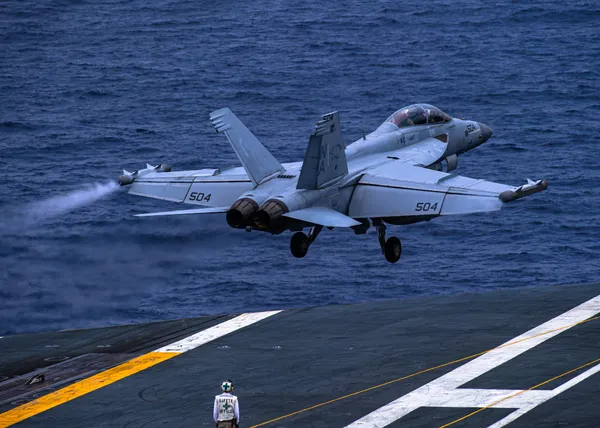
A U.S. Navy investigation has concluded that human error was the primary cause of the EA-18G Growler jet that crashed into San Diego Bay during an attempted landing last winter, a finding that rules out mechanical failure as the initiating factor.
The crash occurred at about 10:15 a.m. on Feb. 12, 2025, during an aborted landing approach to Naval Air Station North Island. The aircraft went down in the bay near Shelter Island, a heavily trafficked area for recreational boating and commercial harbor activity. The two-person crew ejected before impact, were recovered from the water by a nearby sportfishing vessel, transferred to a federal maritime law-enforcement boat, and taken to a local hospital for evaluation. No civilian injuries or onshore property damage were reported in initial Navy updates.
Environmental response and recovery operations
In the immediate response, the Navy and maritime partners secured the site, deployed containment measures, and began assessing potential environmental impacts. Early incident reporting identified jet fuel as the primary product of concern and estimated that up to roughly 300 gallons could have been at risk of release, with responders tracking sheen and debris in the surrounding waters.
Recovery of the aircraft proceeded in phases. By early March 2025, the Navy said salvage teams had completed wreckage removal after collecting more than 30,000 pounds of debris from a debris field measured in thousands of square feet. The Navy reported that the recovery team reviewed the site and notified relevant regulatory agencies before concluding salvage operations.
What the human-error finding does and does not establish
While the Navy’s conclusion identifies human error as the causal factor, the available public details indicate the mishap occurred in the context of an aborted landing sequence and challenging conditions described at the time as rainy and misty. Separately reported summaries of the investigation note that adverse weather was considered among the contributing factors that compounded the crew’s decision-making and the outcome.
The determination that mechanical failure was not the cause narrows the focus to operational and human-factors issues, such as crew actions, adherence to procedures during a go-around or aborted landing, and coordination in the approach environment. However, the public-facing material does not provide a full step-by-step reconstruction, nor does it specify whether any individual actions led to administrative or training consequences.
Why the findings matter for San Diego’s aviation and harbor corridors
San Diego’s bay and adjacent neighborhoods sit beneath an unusually complex airspace shared by military aviation, commercial arrivals, and general aviation. The crash’s proximity to populated shoreline areas and boating corridors underscores the importance of procedural rigor during low-altitude maneuvering near the harbor entrance.
- The incident involved an EA-18G Growler, a two-seat electronic attack aircraft.
- The crew survived after ejection and rapid maritime rescue.
- The aircraft was recovered and removed from the bay in a large-scale salvage operation completed in March 2025.
- The final causal finding attributes the crash to human error and excludes mechanical failure as the initiating cause.
The investigation’s conclusion centers accountability on operational decision-making rather than a materiel defect, reinforcing that approach and landing phases remain among the most risk-intensive segments of military flight operations.
San Diego County Supervisors Approve Ordinance Allowing Separate ADU Sales, Aligning Local Rules With State Law
Breezy Mornings and Big Changes: Your Thursday Briefing