NASA’s Artemis II Orion capsule is planned to splash down in the Pacific Ocean off San Diego
San Diego positioned for high-profile recovery operations after the first crewed Artemis flight
NASA’s Artemis II mission is designed to conclude with a Pacific Ocean splashdown off the San Diego coast, placing the region at the center of recovery operations for the first crewed flight of the agency’s Artemis program. Artemis II is planned as an approximately 10-day mission that will send four astronauts on a lunar flyby and return them to Earth aboard the Orion crew capsule.
The crew assigned to Artemis II includes NASA astronauts Reid Wiseman, Victor Glover and Christina Koch, along with Canadian Space Agency astronaut Jeremy Hansen. The mission is intended to validate Orion’s systems in deep space with a crew onboard, building on the uncrewed Artemis I flight that demonstrated key elements of the spacecraft’s re-entry and splashdown sequence.
Why the splashdown is planned near San Diego
NASA’s recovery planning for Artemis missions has focused on the Pacific as a landing zone to support coordination with U.S. Department of Defense assets and to leverage a mature West Coast maritime and aviation operating environment. The agency has repeatedly rehearsed a post-splashdown recovery architecture off San Diego using an Orion crew module test article, practicing how astronauts would be transferred from the capsule to small boats and then moved to a Navy ship for immediate medical checks and post-mission procedures.
These rehearsals have included helicopter operations, small-boat approaches, and shipboard handling of the capsule. The objective is to reduce risk during the most time-critical phase after landing: securing the crew, assessing medical condition, and stabilizing the spacecraft for transport.
How recovery operations are expected to unfold
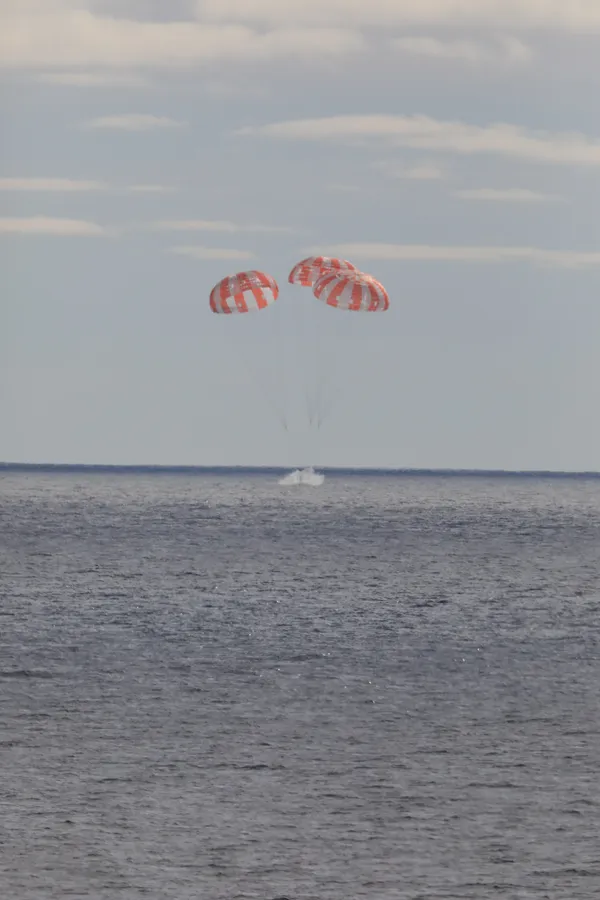
Orion is designed to slow down from lunar-return speeds through atmospheric re-entry and parachute deployment, then splash down under parachutes in the Pacific. After landing, recovery teams are expected to establish a safety perimeter around the capsule, account for hardware that separates during descent, and prepare for crew egress.
Recovery forces approach Orion by small boat after splashdown and assess capsule stability.
A crew transfer process moves astronauts from the capsule to a raft or small craft for transport to a Navy ship.
The capsule is then secured and brought aboard for post-flight handling and shipment back to NASA facilities.
Local public interest and operational constraints
While the splashdown is described as “off San Diego,” the exact landing point is mission-dependent and can shift based on trajectory targeting and weather, with recovery operations typically taking place well offshore. That distance can limit any direct onshore viewing, even as San Diego remains the primary regional hub for recovery staging and maritime support.
Artemis II is intended to be a full end-to-end test of crewed Orion operations in deep space, including the final recovery phase in the Pacific.
NASA continues to treat the splashdown and recovery segment as an integrated part of mission readiness, with repeated joint rehearsals intended to ensure the crew and spacecraft can be retrieved efficiently under realistic sea conditions.