Measles Reaches Highest U.S. Levels in Decades as San Diego County Vaccination Coverage Slips
A national resurgence with local implications
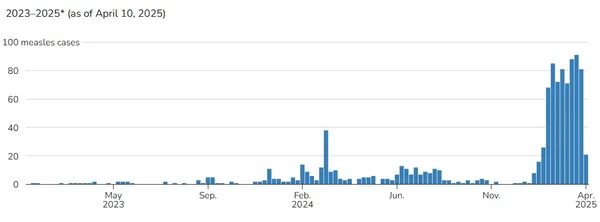
Measles activity in the United States has climbed to levels not seen in decades, driven largely by outbreaks and pockets of under-immunization. Federal surveillance tallied 2,242 confirmed measles cases in 2025 across 45 jurisdictions, with 49 outbreaks and the vast majority of cases linked to outbreak transmission. Early 2026 counts showed 171 confirmed cases reported in nine jurisdictions, with most cases still tied to outbreak chains that began in 2025.
Measles was declared eliminated in the United States in 2000, a designation that can be jeopardized when sustained transmission persists. Public health officials have warned that prolonged outbreaks and declining vaccination coverage increase the likelihood of extended spread.
Where San Diego County fits into the risk picture
California reported 25 confirmed measles cases in 2025 across multiple jurisdictions, including San Diego. While statewide totals remained far below the largest outbreak states, local vulnerability is shaped less by annual case counts than by immunity levels in schools and communities and by travel-related introductions.
San Diego County’s measles-mumps-rubella (MMR) vaccination coverage among kindergarten students has slipped just below the 95% threshold often cited as necessary to reduce the likelihood of sustained transmission. County health messaging during prior travel periods emphasized that increased movement between regions can raise exposure risk even when local case counts are low.
Why outbreaks expand: transmission dynamics and immunity gaps
Measles is among the most contagious viral diseases and spreads through the air. In indoor settings, infectious particles can linger after an infected person leaves, creating opportunities for rapid spread among unvaccinated or under-vaccinated groups.
Two doses of the MMR vaccine provide high protection against measles. Outbreak investigations nationally have repeatedly shown that most infections occur in people who are unvaccinated or whose vaccination status is unknown.
What residents should watch for
Early symptoms commonly include fever, cough, runny nose, and red eyes, followed by a rash that typically starts on the face and spreads downward.
People are contagious from several days before the rash appears through several days after.
Infants too young for routine vaccination and people with weakened immune systems face higher risks of complications.
Public health risk in San Diego County is shaped by two factors working together: the likelihood of importation through travel and the presence of local immunity gaps that can allow transmission to continue.
Health officials continue to urge residents to confirm that they and their children are up to date on MMR vaccination, particularly ahead of travel and in households with infants or medically vulnerable family members.