A rare green flash over San Diego sunsets: what it is, when it appears, and why
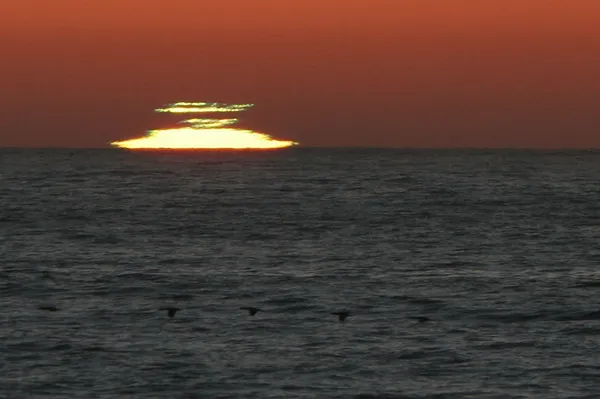
A brief, real optical phenomenon at the horizon
San Diego sunsets occasionally produce a striking, short-lived visual effect: a thin green rim or a momentary green “spark” on the Sun’s upper edge as it meets the ocean horizon. Known as the “green flash,” the phenomenon typically lasts only a second or two and is most often seen at the final moment of sunset or the first moment of sunrise.
Despite the nickname, the effect is not a lightning-like burst. It is an atmospheric optics event created by the way Earth’s air bends and filters sunlight when the Sun is very low in the sky.
Why the Sun can look green for an instant
Sunlight contains many wavelengths that human eyes perceive as different colors. When the Sun is near the horizon, its light passes through a much longer path in the atmosphere than it does at midday. That long, low-angle path makes the atmosphere behave like a weak prism, separating colors because different wavelengths bend by slightly different amounts.
In general, shorter-wavelength light bends more than longer-wavelength light. Near the horizon, the image of the Sun can become subtly “stacked” by color, with redder light displaced slightly differently than greener and bluer light. Under many conditions, blue and violet components are scattered out of the direct line of sight, while red and orange tones dominate the rest of the disk. For a brief interval—when the lower, redder portion of the Sun drops below the horizon—the remaining visible upper edge can appear green.
Why San Diego’s coastline can be a favorable setting
Coastal viewing increases the odds because the ocean provides a distant, relatively flat horizon, allowing the Sun’s edge to be seen cleanly as it sets. Local weather patterns can either help or hinder the view. Marine layer clouds, haze, or smoke can block the last sliver of the Sun and prevent the effect from being visible at all. On clearer days, especially when the horizon line is crisp, observers have a better chance of seeing a distinct green edge.
Conditions that increase (or reduce) the odds
Clear, stable air near the horizon tends to make the flash easier to distinguish.
A distant, unobstructed horizon—often over the Pacific—helps preserve a sharp solar edge.
Atmospheric layering or temperature inversions over water can enhance the effect, sometimes producing more dramatic shapes or repeated color separations.
Fog, low clouds, heavy haze, dust, and wildfire smoke commonly suppress visibility by scattering and absorbing light.
What people see—and what it is not
Most sightings are described as a thin green line or a small green cap on the Sun’s top edge right as it disappears. More rarely, observers report a “green ray” appearance, which is also linked to strong atmospheric refraction and mirage-like conditions.
The green flash is a natural result of atmospheric refraction and color dispersion near the horizon, not an astronomical change in the Sun itself.
Viewing safety
Directly watching the Sun can damage eyesight. If attempting to observe the effect, the safest approach is to avoid prolonged staring and wait until the Sun is at the very last moments of setting, when brightness is reduced. Using optical aids such as binoculars or telephoto lenses introduces additional risk and requires appropriate solar-safe precautions.
For San Diego residents and visitors, the green flash remains an uncommon but repeatable event—dependent less on luck than on clear horizons, stable air, and timing at the day’s final seconds of sunlight.